Robot Certification Market Research Report
Global Market Size, Share & Trends Analysis Report, 2026-2035
Segmentation Analysis By Certification Type: By Robot Type: By End-use Industry: By Service Type: By Certification Body: By Region and Industry Forecast
1. Market Summary:
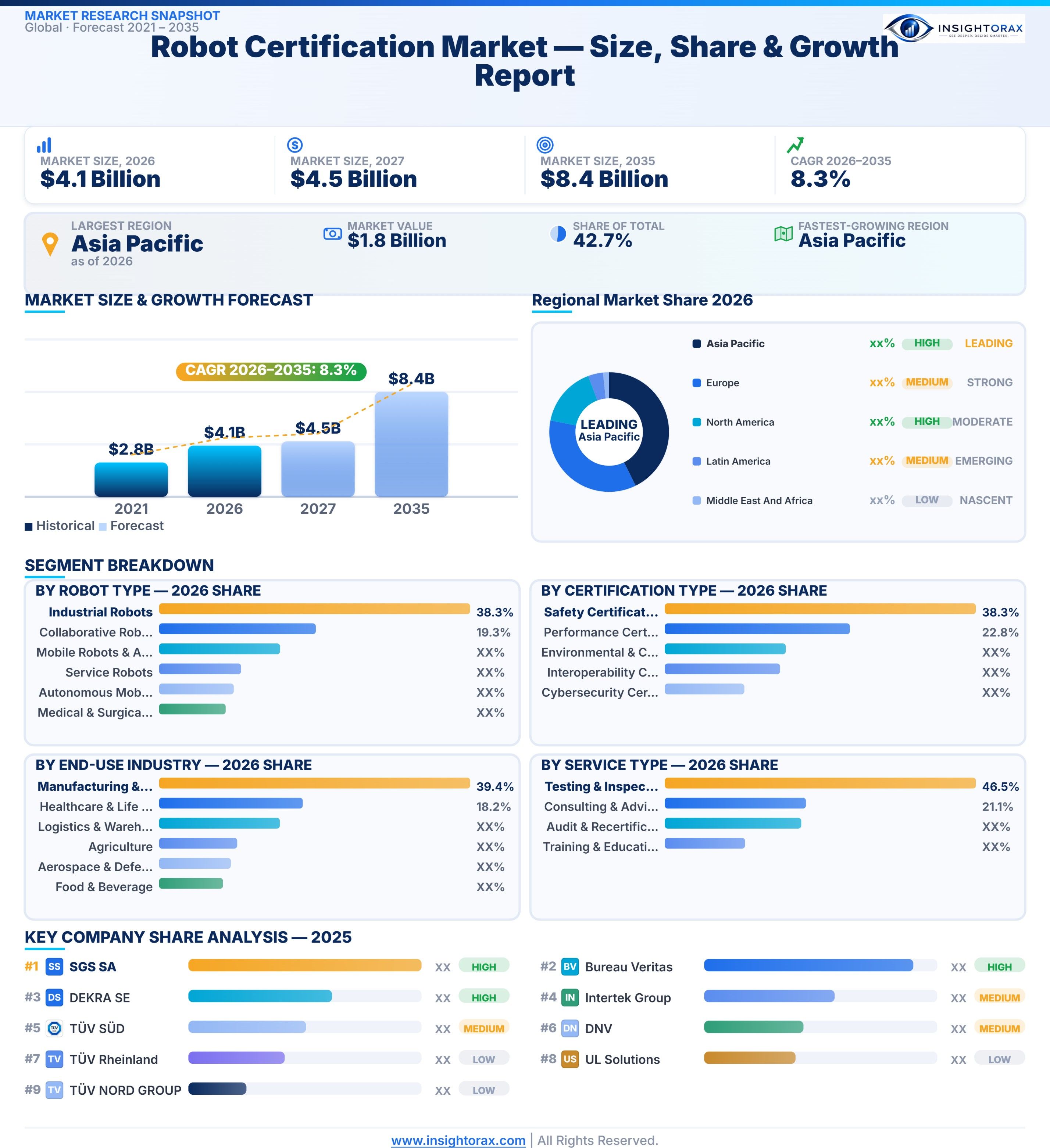
According to data analyzed by Insightorax, the global robot certification market size was valued at USD 4.1 billion in 2026 and is projected to grow from USD 4.4 billion in 2027 to USD 8.4 billion by 2035, registering a CAGR of 8.3% during the 2026–2035 forecast period. Asia Pacific accounted for the largest revenue share of 42.3% in 2026. Market growth is supported by the rapid adoption of industrial, collaborative, autonomous, and service robots across manufacturing, logistics, healthcare, automotive, and other sectors. Increasing workplace safety requirements, evolving international standards, and stronger regulatory compliance are encouraging manufacturers and system integrators to obtain certification before deployment. Demand is further strengthened by human-robot collaboration, AI-enabled robotics, cross-border market access requirements, and the need to validate robot safety, reliability, and performance.
2. Market Overview:
The Robot Certification Market refers to the ecosystem of testing, inspection, assessment, and certification services used to verify that robotic systems comply with applicable safety, performance, quality, and regulatory requirements. It covers certification activities for industrial robots, collaborative robots, mobile robots, autonomous robotic systems, and specialized robots used across manufacturing, logistics, healthcare, automotive, electronics, and other industries. The market supports organizations in demonstrating that robotic equipment meets established technical standards before deployment or during operational use.
The market scope includes robot safety certification, functional and performance testing, electromagnetic compatibility assessment, risk assessment, inspection, compliance evaluation, and documentation. Key components include certification bodies, testing laboratories, inspection organizations, robot manufacturers, system integrators, and end users. Certification requirements can address machine safety, human-robot interaction, electrical safety, software-related functions, cybersecurity considerations, and operational reliability. The market also encompasses certification services for individual robots, robotic systems, components, and integrated automation environments.
3. Market Size & Forecast:
The Robot Certification Market has evolved alongside the increasing use of robotics in industrial automation. Early certification activities primarily focused on machine safety, electrical compliance, and basic performance requirements for industrial robots. As robotic technologies became more sophisticated, certification frameworks expanded to address collaborative operation, autonomous functions, integrated robotic systems, and increasingly complex operating environments.
The market is currently expanding as manufacturers and end users place greater emphasis on workplace safety, regulatory compliance, reliability, and risk reduction. Future growth is expected to remain strong as robotics adoption spreads across manufacturing, logistics, healthcare, automotive, electronics, and other sectors. The development of collaborative and autonomous robots, stricter safety standards, cross-border regulatory requirements, and growing demand for validated robotic performance will encourage more organizations to seek independent testing and certification. Increasing integration of AI and advanced sensing technologies will further strengthen the need for comprehensive certification services.
Key Market Trends & Insights
- By robot type: Industrial Robots segment dominated the market with a 38.3% share in 2026.
- By certification type: Safety Certification segment led the market in terms of share, accounting for 38.3% in 2026.
- By end-use industry: Manufacturing & Automotive segment commanded the largest market share at 39.4% in 2026.
- By service type: Testing & Inspection segment accounted for the highest market share of 46.5% in 2026.
- By certification body: Third-party Certification Agencies segment maintained a leading position in the market, holding a 62.3% share in 2026.
Regional Highlights
- Largest regional market: Asia Pacific (42.2% revenue share, 2026)
- Fastest-growing regional market: Asia Pacific (highest CAGR, 2026-2035)
- By country: China held the largest market share 16.0% in 2026
Market Size & Forecast
- Market size in 2026: USD 4.1 Billion
- Estimated market size in 2027: USD 4.5 Billion
- Projected market size by 2035: USD 8.4 Billion
- CAGR (2026-2035): 8.3%
4. Market Drivers, Restraints & Opportunities:
The Robot Certification Market is driven by the rapid adoption of industrial and collaborative robots, increasing workplace safety requirements, stricter regulatory standards, and growing demand for reliable automated systems. Manufacturers and end users are placing greater emphasis on risk assessment, compliance validation, and performance verification as robots become more integrated into critical production and service environments. Expansion of robotics across automotive, electronics, logistics, healthcare, and manufacturing is also increasing certification requirements. However, high certification costs, complex testing procedures, evolving technical standards, limited awareness among smaller businesses, and differences in regulatory requirements across countries can restrain market development.
Opportunities are emerging from the expansion of autonomous and collaborative robotics, AI-enabled systems, and robotic applications in new industries. Growing international deployment of robots is creating demand for standardized certification and cross-border compliance services. Certification providers can also benefit from digital testing technologies, remote assessment capabilities, specialized safety evaluations, cybersecurity verification, and lifecycle certification services as organizations seek continuous validation throughout robotic system deployment and operation.
5. Market Trends:
The Robot Certification Market is increasingly shaped by the adoption of collaborative robots, autonomous mobile robots, and AI-enabled robotic systems, which require broader safety and performance assessments than conventional industrial robots. Recent developments in international robot safety standards are encouraging manufacturers and integrators to strengthen risk assessment, functional safety, human-robot interaction testing, and system-level compliance. Digital inspection, simulation-based testing, and remote assessment are also gaining attention as certification providers seek faster and more flexible evaluation processes. Growing emphasis on cybersecurity and software reliability is further expanding certification requirements for connected and intelligent robotic systems.
Regionally, Asia-Pacific remains a major hub for robotics deployment, particularly across manufacturing-intensive economies, supporting demand for certification and compliance services. Europe continues to emphasize stringent machinery safety and regulatory compliance, while North America is experiencing demand from automation, logistics, and advanced manufacturing. Emerging markets are also gradually increasing certification adoption as industrial automation expands.
6. Technology Landscape:
The technology landscape is evolving as robotic systems incorporate advanced sensors, machine vision, artificial intelligence, connectivity, and increasingly autonomous functions. These technologies enable robots to perceive environments, make decisions, navigate dynamic workplaces, and interact more closely with people. Certification processes are consequently expanding beyond traditional mechanical and electrical safety assessments toward validation of sensing systems, safety-related controls, software functions, human-robot interaction, and integrated system performance. Simulation and digital testing tools are also supporting more efficient evaluation before physical deployment.
Connected robots are increasing the importance of cybersecurity, data integrity, and software reliability, particularly in networked industrial and logistics environments. Collaborative and mobile robotics are driving demand for application-specific testing because their operating conditions differ from fixed industrial equipment. Advances in AI-enabled robotics may further increase the need for structured validation as system behavior becomes more complex. These developments are encouraging certification providers to adopt digital assessment methods and broader, system-level evaluation approaches.
7. Robot Certification Market Segmentation Analysis:
8. By Certification Type:
Safety Certification remains the leading category because robotic systems must be assessed for hazards involving movement, machinery, electrical systems, safeguarding, and human interaction. Demand is increasing with wider deployment of collaborative and autonomous equipment in workplaces. Performance Certification is gaining importance as users seek documented evidence of accuracy, repeatability, reliability, and functional capabilities. Interoperability Certification is becoming more relevant as robots increasingly operate alongside sensors, software, controllers, and connected equipment from different suppliers.
Cybersecurity Certification is emerging rapidly as connected robots exchange operational data across networks and cloud platforms. Organizations increasingly require protection against unauthorized access, manipulation, and system disruption. Environmental and Compliance Certification supports conformity with applicable electrical, electromagnetic, environmental, and regional requirements. Together, these categories are broadening assessment beyond traditional mechanical safety. Their importance is expected to increase as robotic systems become more intelligent, connected, autonomous, and integrated into safety-sensitive operating environments.
9. By Robot Type:
Industrial Robots continue to generate substantial certification demand because of their widespread use in assembly, welding, painting, machining, packaging, and other automated processes. Collaborative robots are expanding as manufacturers introduce systems designed to work alongside people, increasing the need for specialized assessments covering human-robot interaction and safeguarding. Mobile robots and AGVs are also gaining adoption in factories and warehouses, creating requirements related to navigation, collision avoidance, and operational safety.
Service robots are expanding across hospitality, cleaning, retail, and other customer-facing applications, while medical and surgical robots require rigorous evaluation because reliability and safety are critical in healthcare environments. Autonomous mobile robots represent a fast-developing area, particularly in logistics and material movement, where autonomous navigation and sensor-based decision-making create additional assessment requirements. The diversity of robotic platforms is increasing demand for application-specific testing, helping certification providers expand beyond conventional industrial equipment toward increasingly autonomous and intelligent systems.
10. By End-use Industry:
Manufacturing and automotive industries remain major users of robotic systems because automation supports high-volume production, precision, quality control, and workplace safety. Healthcare and life sciences are generating specialized demand as robotic technologies expand in surgery, rehabilitation, laboratory automation, pharmaceutical production, and medical logistics. Logistics and warehousing are also experiencing strong adoption of automated handling systems, AGVs, and AMRs to improve throughput and reduce manual movement.
Aerospace and defense applications require highly reliable robotic systems for inspection, assembly, maintenance, hazardous environments, and specialized operations, creating demand for rigorous testing. Food and beverage producers increasingly use robots for packaging, handling, processing, and inspection, where hygiene and operational requirements influence certification needs. Agriculture is an emerging application area as autonomous machines support harvesting, monitoring, spraying, and other activities. Expanding automation across these industries is broadening certification demand and increasing the importance of sector-specific compliance and safety assessment.
11. By Service Type:
Testing and Inspection represents a fundamental service category, covering assessments of safety, performance, electrical characteristics, functional systems, and compliance with applicable standards. Demand is increasing as manufacturers and integrators introduce increasingly complex robots into workplaces. Consulting and Advisory services support organizations with risk assessment, standards interpretation, regulatory planning, technical documentation, and preparation for certification, particularly when requirements differ between markets.
Training and Education services help manufacturers, integrators, and operators understand applicable standards, risk-management practices, and safe deployment procedures. Audit and Recertification services support ongoing conformity by reviewing systems after modifications, upgrades, or defined certification intervals. These services are becoming more important as robotic platforms receive software updates and undergo operational changes throughout their lifecycles. The combination of technical testing, advisory support, workforce education, and recurring assessment enables certification providers to build longer-term relationships while helping customers maintain compliance as technologies and regulatory requirements evolve.
12. By Certification Body:
Third-party Certification Agencies play an important role by providing independent testing, inspection, conformity assessment, and certification services. Their independence can strengthen customer confidence and support regulatory or market-access requirements. International Standards Organizations influence the market by developing technical frameworks and safety standards that guide manufacturers, integrators, testing laboratories, and certification bodies. Their work establishes common reference points for evaluating robotic systems across different markets.
Government and Regulatory Bodies shape certification requirements through legislation, workplace safety rules, conformity procedures, and enforcement mechanisms. Their influence varies by jurisdiction and robot application. OEM Self-certification is used in circumstances where manufacturers can demonstrate conformity through internal procedures and applicable regulatory frameworks, although the requirements depend on the relevant jurisdiction and product category. As robotic systems become more connected and autonomous, certification bodies are expected to strengthen capabilities in cybersecurity, functional safety, software validation, and system integration. These developments will increase the importance of credible, technically competent assessment organizations
13. Regional Analysis:
Asia-Pacific represents a major regional market, supported by extensive industrial automation, large manufacturing bases, and rising deployment of industrial and collaborative robots across countries such as China, Japan, South Korea, and India. Increasing investment in smart factories, electronics production, automotive manufacturing, and logistics automation is strengthening demand for testing and compliance assessment. Europe also maintains strong demand because of established industrial robotics adoption and stringent product safety and machinery requirements. The region’s emphasis on workplace safety, conformity assessment, and standardized technical requirements supports certification activity across manufacturing and emerging robotic applications.
North America is driven by automation investments in manufacturing, warehousing, logistics, and healthcare, with the United States representing a key contributor. Demand is supported by workplace safety practices, industry standards, and increasing adoption of collaborative and mobile robots. Latin America and the Middle East & Africa are developing markets, where expanding industrial automation, logistics modernization, and technology investment are gradually creating additional opportunities for certification and compliance services.
14. Competitive Landscape:
Competition in the Robot Certification Market is shaped by testing laboratories, inspection organizations, certification bodies, and specialized safety assessment providers. Companies differentiate through technical expertise, accreditation, faster testing cycles, broader service portfolios, and capabilities covering industrial, collaborative, mobile, and specialized robotic systems. Geographic expansion is supported by establishing regional testing capabilities and serving manufacturers seeking compliance across multiple jurisdictions. Partnerships with robot manufacturers, system integrators, research institutions, and industry organizations help providers strengthen technical capabilities and expand customer access.
Leading providers increasingly adopt digital inspection, simulation, automated testing, and remote assessment technologies to improve efficiency and address increasingly complex robotic systems. Businesses are also expanding services to cover functional safety, cybersecurity, software validation, and human-robot interaction. Relevant certifications and accreditation strengthen market credibility, while strategic collaborations and integrated compliance services help retain customers. Organic inputs are not applicable to this market; competitive strategies instead focus on technological expertise, regulatory knowledge, service quality, international coverage, and specialized testing capabilities.
15. Key Robot Certification Company Insights:
The Robot Certification Market features established testing, inspection, and certification organizations competing through technical expertise, accredited laboratories, regulatory knowledge, global reach, and specialized robotics services. UL Solutions provides testing and certification for industrial, collaborative, mobile, consumer, and commercial robots, while TÜV SÜD supports robotic safety testing, product certification, and auditing across the product lifecycle. TÜV Rheinland provides services for industrial, collaborative, autonomous mobile, and service robots, covering testing, functional safety, and international conformity requirements. Other prominent participants include SGS, Intertek, Bureau Veritas, DEKRA, TÜV NORD, CSA Group, DNV, Applus+, Eurofins, Kiwa, Nemko, Element Materials Technology, and MET Laboratories.
Competition increasingly centers on service breadth, certification speed, international market access, and the ability to address complex robotic technologies. Providers are expanding capabilities in functional safety, human-robot interaction, cybersecurity, software validation, performance testing, and risk assessment. Partnerships with robot manufacturers, system integrators, research organizations, and industry bodies support technical development and customer acquisition. Geographic expansion through regional laboratories and conformity-assessment networks enables companies to serve manufacturers entering multiple markets. Digital inspection, simulation-based assessment, and remote testing are also becoming important differentiators as autonomous, collaborative, and connected robots increase certification complexity.
· TÜV SÜD – Provides robotics and machinery safety assessment, functional-safety services, testing, inspection and certification. Its positioning is particularly strong in industrial automation, machinery safety and international conformity assessment.
· TÜV Rheinland – Offers testing, inspection and certification for robotics, machinery and automated systems, with expertise spanning functional safety, electrical safety, EMC and regulatory market access. Its global TIC network supports multinational robot manufacturers.
· TÜV NORD GROUP – Focuses on industrial machinery safety, testing, inspection and certification. Its capabilities support robot manufacturers and integrators seeking compliance with European and international safety requirements.
· SGS SA – Provides robotic product testing and certification covering safety, performance, cybersecurity and regulatory compliance. Its broad global laboratory and TIC infrastructure supports robot manufacturers entering multiple markets.
· Bureau Veritas – Provides product testing, inspection and certification across industrial technologies. Its strengths include conformity assessment, regulatory compliance and international market access for equipment manufacturers.
16. Key Robot Certification Companies:
· TÜV Rheinland
· TÜV NORD
· SGS SA
· Bureau Veritas
· Intertek Group
· UL Solutions
· DNV
· DEKRA SE
· CSA Group
· NSF International
· Eurofins Scientific
· RINA S.p.A.
· Applus+
· Element Materials Technology
· Southwest Research Institute (SWRI)
· MET Laboratories
· exida
· SIRA Certification Service
· Certification Europe
17. Recent Developments:
In 2025, ISO published revised editions of ISO 10218-1 and ISO 10218-2, updating safety requirements for industrial robots and robotic applications. The revisions address areas including robot safety, risk reduction, functional safety, and integration requirements, creating new compliance considerations for manufacturers, integrators, and certification providers.
· March 4, 2026 — UL Solutions: Certified Simbe’s Tally autonomous mobile robot under UL 3300 after it passed more than 40 safety tests, supporting safe deployment in public-facing retail environments.
· April 21, 2026 — TÜV Rheinland: Reported €2.98 billion revenue in 2025, up 9.7%, reflecting continued international expansion and investment in testing, inspection, certification, and future technologies.
· May 6, 2026 — SGS: Verified DOBOT’s CR 30H collaborative robot series against the cybersecurity requirements of ISO 10218-1:2025, following a February 2026 Verification of Conformity.
· April 9, 2026 — TÜV NORD GROUP: Reported €1.795 billion revenue in 2025, up 6.0%, while emphasizing digitalization, cybersecurity, critical-infrastructure protection, and safety-relevant technology markets.
· April 17, 2026 — DEKRA: Reported €4.4417 billion revenue in 2025, up 3.4%, with continued demand for testing and certification services and further emphasis on technology, digital trust, and safety.
18. Future Outlook:
The Robot Certification Market is expected to maintain a positive growth trajectory as robotics adoption expands across manufacturing, logistics, healthcare, and other automated environments. The publication of updated ISO 10218-1:2025 and ISO 10218-2:2025 standards is increasing the importance of structured safety assessment, risk reduction, and integration compliance. Growing deployment of collaborative, mobile, and connected robots will create opportunities for specialized testing and certification services.
Future opportunities will increasingly center on functional safety, cybersecurity, human-robot interaction, software validation, and digital assessment methods. Certification providers can expand through international conformity services and application-specific testing as manufacturers seek access to multiple markets. However, evolving standards, complex robotic architectures, high assessment costs, and differences among regional regulatory frameworks may create challenges. The need to evaluate increasingly autonomous systems will encourage broader, system-level certification approaches.
19. Methodology Overview
Extensive research from reliable academic sources, industry reports, and publications.
Interviews with industry experts, opinion leaders, and key stakeholders.
Validation of data through top-down and bottom-up approaches.